You are viewing South Asia
Choose Your Location:
- United States
- Canada
- Latin America
- EMENA
- Sub-Saharan Africa
- Russia
- South Asia
- Asia Pacific
- China
- Global
Choose Your Location:


United States


Canada


Latin America


EMENA


Sub-Saharan Africa


Russia


South Asia


Asia Pacific


China


Global










Popular Searches

How to Manage Heat Stress in Broilers During Summer for Better Performance
Key Takeaways
- Heat stress can significantly impact broiler health and productivity, reducing feed intake, growth performance, and overall flock efficiency during hot weather conditions.
- Effective summer management requires a combination of nutrition, ventilation, and environmental control, helping birds maintain comfort and performance.
- Proper hydration and nutritional support are critical during periods of heat stress, helping broilers cope with temperature-related challenges.
- A proactive approach to heat stress management can improve bird welfare and production outcomes, supporting healthier flocks throughout the summer season.
Summer stress not only affects broiler performance, but it is an important stress factor which is responsible for immunosuppression, leading to disease outbreaks affecting the economics of broiler farming. For broilers, 21-27°C temperature is considered as comfort zone (thermoneutral zone). When temperature goes above that, it will lead to summer stress. Higher temperature in summer leads to summer stress due to the absence of sweat glands in poultry, as birds can’t dissipate heat. Broilers gain heat from the open shed, unnecessary handling, dryness of litter, and irregular feeding times which contributes only 1 %, but birds’ body heat formation contributes the most. Birds loose heat by sensible heat loss through radiation, conviction and conduction during thermoneutral zone, and insensible heat loss by evaporation during summer stress condition. Due to limited heat loss capacity of chicken, the heat gain is more than heat loss. This should be balanced for normal physiological functions.
Panting allows the bird to control its body temperature by evaporation of water from the respiratory surfaces and air sacs. High temperature and humidity for longer periods leads to panting, which may be insufficient to control body temperature and the birds experience heat stress. Hot humid conditions are more stressful than hot dry conditions. As a result of panting, heat is lost as moisture evaporated from airways, respiratory rate increases by 10 times and acid/ base balance in blood get disturbed leading to respiratory alkalosis. Loss of carbondioxide (CO2) raises plasma pH, whereas, mineral depletion like potassium (K), reduced growth rate, high humidity and temperature reduces the evaporative heat loss and in severe cases mortality. High environmental temperature stimulates the hypothalamus that activates the adrenocortical axis, increasing the corticosteroid secretion in response to stress.
Birds’ Response to Heat Stress and its Results on Broiler Performance
Birds try to move away from each other and move towards cooler surfaces. They lift their wings away from their bodies. Birds pant slowly and rest to reduce the heat generated by activity. Due to this, there will be reduced feed intake and an increase in water consumption. Blood is diverted from internal organs to skin and the birds’ begin to pant fast.
Heat stress in summer leads to reduced feed consumption, lower body weight gain, high feed conversion ratio (FCR) and dehydration. Summer stress also results in immuno-deficiency and disease outbreaks in broilers. An increase in energy demands, increased culls and high mortality are observed due to heat stress.
How to Manage Heat and Summer Stress in Broilers?
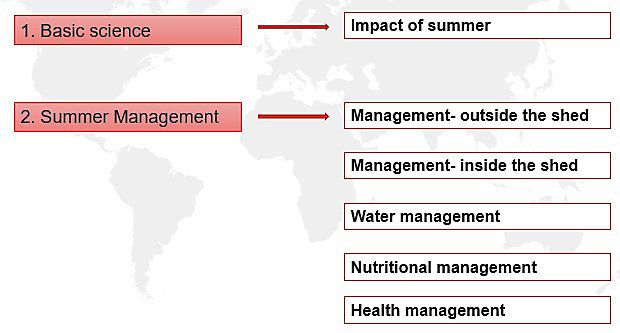
Two important aspects to consider during heat stress are, basic science and the impact of summer on broiler birds and summer management.
Summer Management of Broilers Outside the Shed
- Thatching of roof top with green grasses or agriculture waste keeps the shed cool. Agriculture waste like dry grasses or fodders or dry coconut branches or paddy straw can be used for thaching of roof, which will help to minimize the sheds internal temperature.
- Provide monkey top over asbestos roof and ensure that smoke tiles are at 10 feet interval without any block for good exhaust. This will improve the ventilation and act as an exhaust for removing light air or CO2 formed inside shed.
- Provide outlets on tiles for ventilation and 6 feet side pandal in south side of the shed to avoid sunlight. This will avoid entery of direct sunlight into shed during noon hours, and will help to get more feeding and drinker space to birds during summer season.
- Ensure that there is no entry for wild birds or domestic animals, other wise there may be chances of spreading of diseases outbreak due to improper biosecurity.
- Grow trees and maintain outside area clean for free flow of air around the shed,which will help to improve clean and cold air to birds inside shed.
- Whitewash the roof top with lime, cement and water that will reflect the direct sunlight. It will minimize the internal shed temperature by the reflection of direct sunrays during hot hours.
- Gunny cloth with drip water system is set up in extreme hot climate and make use of green net/ thin gunny bags that provide cooling effects to the birds.
- Clean the cobwebs on side shed net which may restrict the air movement. Regular cobwebs removal will help to improve the ventilation, otherwise cobwebs may minimize airflow by 20%.
- Make temporary arrangements for the birds to stay, feed and drink in the daytime along the sides of shed. Free land growing during day time will improve the feed intake and help to minimize heat stress during summer.
Summer Management of Broilers Inside the Shed
- Birds should get daily aerial spray of disinfectant. Spray cool water during hot climate, by using sprinkelers on shed, installing horizontal fans and providing foggers inside the shed allows free cross ventilation in between the sheds.
- Maintain optimum moisture of litter to avoid dustiness, otherwise such duct will be inhaled by birds which may aggrivate the respiratory problems during summer stress.
- Walk gently inside the birds shed once in a hour, which will activate the birds and helps to improve the water consumption of birds.
- Adopt early heat conditioning or thermal conditioning method to get acclimatization of chicks for higher temperature. Thermal conditioning method is exposing 3 to 5 days old chicks to 38°C for 24 hours resulting in significant improvement of thermotolerance in birds. Early age thermal conditioning appears to induce long term metabolic changes.
- The relationship between low metabolic rate and relatively low body temperature can predict the ability to successfully cope with thermal challenge.
- Thermo-tolerance can be enhanced by early-age heat conditioning during the initial days of a chicks life to boost the survival rate of broilers under heat stress.
- Adopt dual feeding program which includes a protein diet during the cooler parts of the day and an energy-rich diet during the warmer parts of the day.
- Restrict feeding during hotter hours by withdrawing feed during hotter hours of the day.
Water Management for Broilers in Summer
- Cover the water tanks with agriculture waste or gunny cloths to combat the heat stress by maintaining the tank stored with cool water which will improve water consumption.
- Proper covering of pipelines with gunny clothes or insulation of pipelines directly exposed to sunlight will help to maintain the water cooler in pipeline.
- Continuos flushing of water from drinker pipeline will keep the water cold.
- Always provide clean and adequate cold drinking water at adjustable levels in drinker.
- Flush the waterlines with hydrogen peroxide (H2O2) to remove the biofilm from pipelines, which will minimize and avoid the secondary complications due to E. coli and water borne infections during stress or immunosuppression.
Basic Broiler Health Management
Health Management is the combination of three components, viz, water hygiene, vaccination and biosecurity, which are interlinked with each other.
Water Hygiene
Water hygiene is vital for better productivity in broiler farming, as it is the most important nutrient. Hence, water should be clean, properly sanitized and cold, as it is a source of water born infections. Water creates a polysaccharide layer called as biofilm in the water pipelines, mineral deposits like calcium build up and provides shelter for microbes. One single E. coli organism can multiply 1 to 24 trillion in 24 hours. Water pipelines should be clean and flushed periodically with organic acids or H2O2. Treat the water with combinations of good water acidifiers and sanitizers to maintain optimum pH (6 to 6.7) and eliminate the bacterial load in it. Proper precausions has to be taken to store and use water sanitizers & acidifiers to get better efficacy of it.
Vaccination
Vaccination is a key for successful poultry farming. Effective vaccination depends on vaccine strain, vaccination schedule and birds’ immunity status. To get better response to vaccination, immunity status of bird will play a crucial role. Summer stress causes various physiological changes in birds body and there will be hypoglycemia that leads to heavy mortality and results in immunosuppression. Excess secretion of corticosteroids will make the body cell unresponcive to insulin, which leads to reduced weight gain of immune organs like bursa, thymus, etc. This results in reduced antibody production against vaccination, which may lead the birds susceptible for viral infections like Newcastle disease (ND), Infectious bursal disease (IBD), Infectious bronchitis (IB), etc., causing immunosuppression in flocks. To avoid such immunosuppression during summer season, farmers or integrators are advised to use organic chromium along with Vitamin C, that not only improve insulin production with more glucose utilization by body cells, but also minimize oxidative stress and improve the immunity, as chromium & vitamin C has better synergistc effect.
Maintain strict cold chain during transport, storage and administration of vaccines. Don’t restrict the water supply before vaccination through water for longer time. This may lead to dehydration and aggravate the heat stress condition during summer season. Vaccination should be carried out during cool hours as infectious bronchitis and related vaccines are particularly heat sensitive and vaccination response will be affected. Newcastle and bronchitis vaccine reactions can occur in birds hyperventilating because of heat stress.
Vaccination failure is mainly because of:
- Stress like extreme temperature or relative humidity
- Improper handling or administration of vaccine
- Poor distribution like water vaccination
- Already incubating the disease
- Immunosuppression due to any reason
- High level of maternal antibodies
- Poor quality or contaminated vaccines
Care to be taken post vaccination:
- Keep the reconstituted vaccine in the icebox
- Don’t take a break during vaccination
- Destroy all the empty and unused vials
- Vaccination in night or early morning hours
- Record the vaccine details like batch number
Dos and Don’ts During Vaccination
Table-1: The Dos and Don’ts during the vaccination procedures.
Dos | DON’Ts |
Vaccinate healthy birds in cool hours of day | Do not vaccinate under stress |
Correct storage temperature | Don’t use chlorinated water |
Agitate the vaccine solution periodically | Don’t use excessive or under dose |
Reconstitution – 1hour use & store the vial | Don’t use different diluent |
Water withdrawal time & amount of water for vaccination | Don’t shake vials vigorously during reconstitution |
Usage of vaccine for 1.5-2 H in drinking water | Don’t reconstitute all the vials at a time |
Checklist to Prevent Vaccine Failure
- Storage of vaccine: Proper cold chain to be maintained during storage of vaccine.
- Diluent used to be stored properly at specific temperature and pH.
- Reconstitution of vaccine procedure to be followed strictly as per protocol provided.
- Age of vaccination and doing vaccination at cooler hours of the day.
- Immunity status of birds before vaccination should be evaluated or checked.
- Dosing-over or under dosing should be avoided during vaccination.
- Toxins in diluents or vaccines need to be checked before usage.
- Heat stress status to be evaluated before vaccination to get proper response against vaccination.
Biosecurity
Biosecurity is the set of management practices which when followed correctly reduces the potential for introduction and spread of disease-causing organisms onto and between sites. From the perspective of bird rather than just the farm, the biosecurity levels are detailed as below.
Three Key Levels of Biosecurity
- Conceptual Biosecurity- Involves site planning location, for example proximity to other farms, transport, etc. Almost impossible to change once committed without high cost.
- Structural Biosecurity- Concerns the design of farm and building. Includes house design (easy to clean), site layout and security. Expensive to change once built.
- Operational Biosecurity- The points involved with day to day running of the site. Includes routine disinfection, control of visitors, source of stock, etc. It can be modified at low cost according to requirements.
Biosecurity is important to keep lethal, highly contagious diseases out of premises, example Newcastle disease, avian influenza, or acute infectious bronchitis disease.
Route of the Spread of Disease
- Rodents (Salmonella, Pasteurella)
- Feed (Salmonella, some ND strains)
- Wild birds (Mycoplasma, ND, Avian Influenza, IBD, Turkey Rhinotracheitis (TRT), bacteria and worms)
- Water (E. coli, Salmonella, Campylobacter)
- Hatchery (Salmonella, Aspergillus, Enterococcus, Pseudomonas and mycoplasma)
- Windborne (IB, ND, TRT, mycoplasma)
- Faecal (IBD, ND, Salmonella, mycoplasma, viruses)
Control areas for the spread of disease
In-Animates
- Locate the farm away from other poultry
- Avoid waterways, ponds or lakes nearby farm premises
- Avoid putting birds on range
- Avoid major roads from nearby farm
- Remove litter from farm and maintain biosecurity
- Concrete around houses will help to minimize spread of diseses
- Avoid standing water around farms
- Use potable drinking water for poultry consumption
Animates
- Limit staff movements in and out of farms
- Avoid visitors entry in the farms
- Control farm site traffic
- Spray vehicles with disinfectants
- Adequate protective clothing while entering in the farms
- Usage of boots, aprons, gloves, show caps, head caps, etc while entering in farms
- Hand washing
- Showers
Better Health Management Steps for Broiler Farming in Summer
Before summer starts, ND killed vaccine must be given. After summer, ND killed vaccine or ND live vaccine must be given. Organic chromium and synthetic vitamin C combination like Chromflex™ C at 200g/MT of feed is used to minimize the stress, reduce the stress induced hyperglycemia and mortality. Summer stress conditions predispose the birds to the problem of Mycoplasma gallisepticum (MG) by suppressing the immune system, and allow other opportunistic invaders to attack the birds like newcastle disease, E. coli, Velogenic Viscerotropic Newcastle disease (VVND), avian influenza, fowl cholera, etc. Apart from this, diseases like infectious bronchitis and factors such as wet litter, coccidiosis, climate and nutritional changes, etc. allow the MG to become more active. Migration of birds during climate change would certainly influence the avian influenza (AI) virus transmission cycle and directly affect virus survival outside the host.
Boosting the immunity in birds by supplementing immunomodulants (Aleta™), regular vaccination for IB, effective coccidiosis programs, good biosecurity and sanitation will prevent the problem of heat stress. Regular sanitization and acidification of drinking water with AcidLAC™ W Conc. Liquid at 1ml/4 litres of water and periodic cleaning of water tanks is necessary, since the undergoing water level increases the bacterial counts in water during summer (mainly E. coli & chronic respiratory disease – CRD). In summer, increased intake and increased excretion of water by birds are responsible for wet litter condition and ammonia production. Hence, it is important to include ammonia binder like BioCURB® Dry at 200g/MT of feed which will reduce ammonia production by proper degradation of protein and help in maintaining litter dry. Adjust the amount of medications and volumes of water used for water vaccination to reflect the increase in water consumption of the flock during hot weather.
To minimize the risk of disease outbreaks during summer, the points below should be considered.
- All-in & all-out system of poultry management in hot climate is mostly preferred.
- At high temperature, rapid evaporation of disinfectant solution results in less contact time. Hence, appropriate disinfection program is followed between the batches and in farm.
- Poor biosecurity during the time of feed withdrawal may lead to problems of coccidiosis and necrotic enteritis.
- Ensure proper disposal of dead birds (Death pit - 6 feet diameter and 6 feet depth for 10,000 birds).
Conclusion
Managemental practices with focus on health management, usage of additives like organic chromium along with Vitamin C will minimize the heat stress and improve the economical benefits to broiler producers. Immunomdulators like 1,3 beta glucan will improve the immunity of flocks during heat stress conditions.
NOTE: References are available on request.

Health Management of Broilers in Summer